ThinkTank: Ideas with a Path Toward Useful Systems
Auzietek ThinkTank is the place where the bigger ideas are allowed to breathe, but not drift away.
Some ideas start as lab work: a PXE pipeline, a Docker Swarm, an OpenStack host, a new user interface, a content deployment, a DNS automation loop, a graph of real infrastructure. Other ideas begin farther out: sustainable communities, new operating-system shapes, modular compute fabrics, and human-first automation.
The rule is simple:
imagination
  -> experiment
  -> evidence
  -> useful system
ThinkTank is not a promise that every idea is ready today. It is a public research bench for ideas that deserve a path from intuition to proof.
Why this exists
The technology industry often splits into two unhelpful modes:
- safe repetition of familiar tools;
- speculative future-talk with no operational receipts.
Auzietek is trying to work in the space between those poles. Keep the imagination. Keep the engineering discipline. Keep the receipts.
That is why BlackKnightController matters to the wider Auzietek story. It turns “I think this should work” into a repeatable operational loop: define the intent, run the procedure, capture evidence, improve the fragment, and try again.
RACS: automation pointed at human need
RACS, the Revolutionary Autonomous Construction and Sustainability concept, is one of the long-range ideas in the ThinkTank lane.
The heart of RACS is not robotics for spectacle. The heart is resilient infrastructure for people:
- modular housing;
- renewable power;
- water reclamation;
- responsible reuse of materials;
- local education centers;
- practical medical access;
- disaster-response capability;
- communities designed for dignity, safety, and opportunity.
The older RACS notes explored eInk learning devices, mesh networking, telemedicine, AI-supported education, robotics, sustainable construction, and emergency deployment. Some parts remain aspirational. Some parts are already made of available tools.
The ThinkTank job is to separate those pieces:
available now
  -> prototypeable with funding
  -> research dependency
  -> speculative future
That framing matters. A good idea should not be thrown away because the full version is ambitious. It should be reduced into testable pieces.
AuziX and next-era computing
AuziX is the operating-system side of the same instinct.
Classic Unix and Linux taught the world durable lessons: text interfaces, composable tools, network-first thinking, and systems that can be understood by a determined human. But modern infrastructure also shows the cost of global state, hidden dependency chains, scattered configuration, and machines that slowly become pets.
AuziX asks what happens if a workstation or small lab OS is designed around clearer contracts:
- human-readable system layout;
- explicit package and runtime receipts;
- isolated services instead of global filesystem drift;
- declarative state that can be inspected and replayed;
- local compute fabric between trusted machines;
- graceful rebuild instead of endless repair;
- “technology as a natural system” rather than a pile of mystery.
That thinking draws from GoboLinux, Plan 9, Nix-style reproducibility, Amiga-era responsiveness, and the practical lessons learned from building real labs by hand.
AuziX is not replacing Linux tomorrow. It is a research lane for ideas that can feed back into today’s tools: cleaner installers, better fragments, deterministic rebuilds, and interfaces that make systems easier to reason about.
New Era Computing
The older New Era Computing concept imagined modular compute systems: fiber or high-speed backplanes, replaceable compute boards, shared resource fabrics, and operating systems that treat a group of machines as a coherent environment.
That future may eventually involve RISC-V, ARM, GPUs, accelerators, or hardware that does not look like today’s servers at all.
But the immediate version is humbler and more useful:
- a lab where hardware can be rebuilt like containers;
- hypervisors provisioned from repeatable pipelines;
- services moved between Proxmox, OpenStack, ESXi, and Swarm;
- DNS, certificates, monitoring, and edge routes controlled through auditable workflows;
- knowledge preserved in fragments so the next run starts from evidence.
The big idea becomes credible only when the small version works.
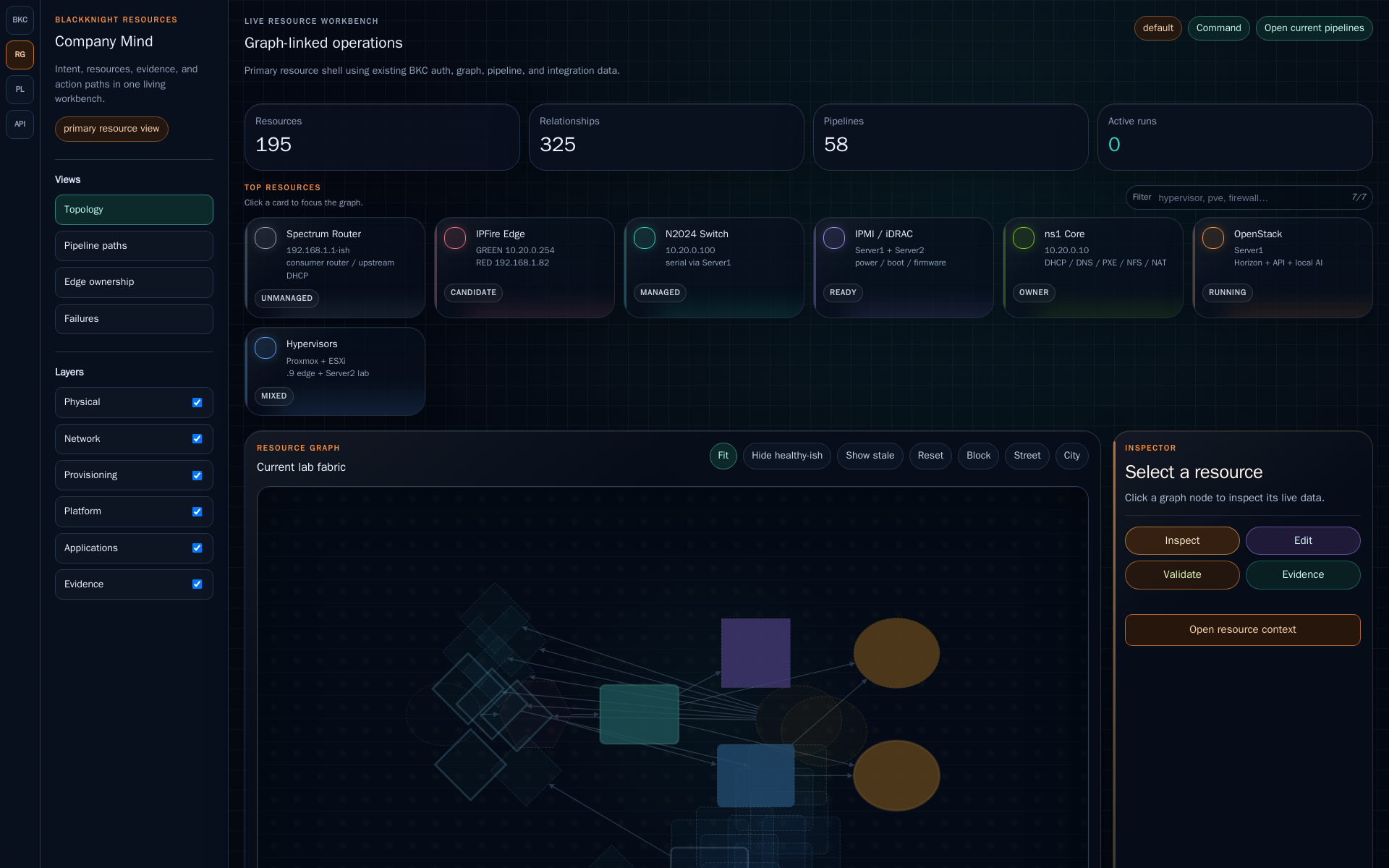
Company Mind
BlackKnightController’s Company Mind work is the practical bridge between ThinkTank and operations.
The graph is not just decoration. It is a way to show relationships:
- a switch sees a MAC address;
- a hypervisor owns a virtual machine;
- a pipeline modifies a host;
- an edge route exposes a service;
- Grafana proves health;
- a receipt explains what changed.
That relationship model is what allows an AI-assisted operator to act like an engineer with memory instead of a chatbot with a terminal.
How ideas graduate
ThinkTank ideas should move through a visible path:
- Name the idea.
- Capture the source material.
- Split claims into testable pieces.
- Build the smallest useful prototype.
- Publish the evidence.
- Turn the working part into a guide, pipeline, or repository.
- Leave the unfinished part clearly marked for future work.
That is the Auzietek way: no smoke and mirrors, but no fear of ambitious thinking either.
Current research lanes
The active ThinkTank map includes:
- BlackKnightController — prompt-to-pipeline operations, infrastructure graphing, fragments, receipts, and governed AIOps.
- AuziX — deterministic workstation and lab OS ideas with explicit state, clean runtime boundaries, and local compute fabric concepts.
- RACS — sustainable autonomous communities, disaster relief, education access, medical access, and infrastructure designed around dignity.
- New Era Computing — modular compute, resource fabrics, edge labs, and future-friendly system architecture.
- Human + AI operations — workflows where people keep intent and ethics while agents reduce toil, preserve evidence, and execute bounded procedures.
The promise
Auzietek is not trying to make technology louder.
The goal is technology that feels more natural, predictable, and clean.
Systems should be understandable. Rebuilds should be normal. Evidence should outlive the chat session. Advanced tools should help young engineers learn, not hide the craft from them.
If these ideas become useful, they should become more than products. They should become part of a practical, humane operating culture: merit over gatekeeping, proof over theater, and automation pointed at making life better rather than merely making dashboards busier.