Auzietek is not trying to sell automation as a slogan.
The useful proof is the working loop: take ordinary infrastructure tasks, capture the steps, validate the result, preserve the fragments, and make the next run easier to explain.
That is what the recent BlackKnightController lab sequence demonstrated.
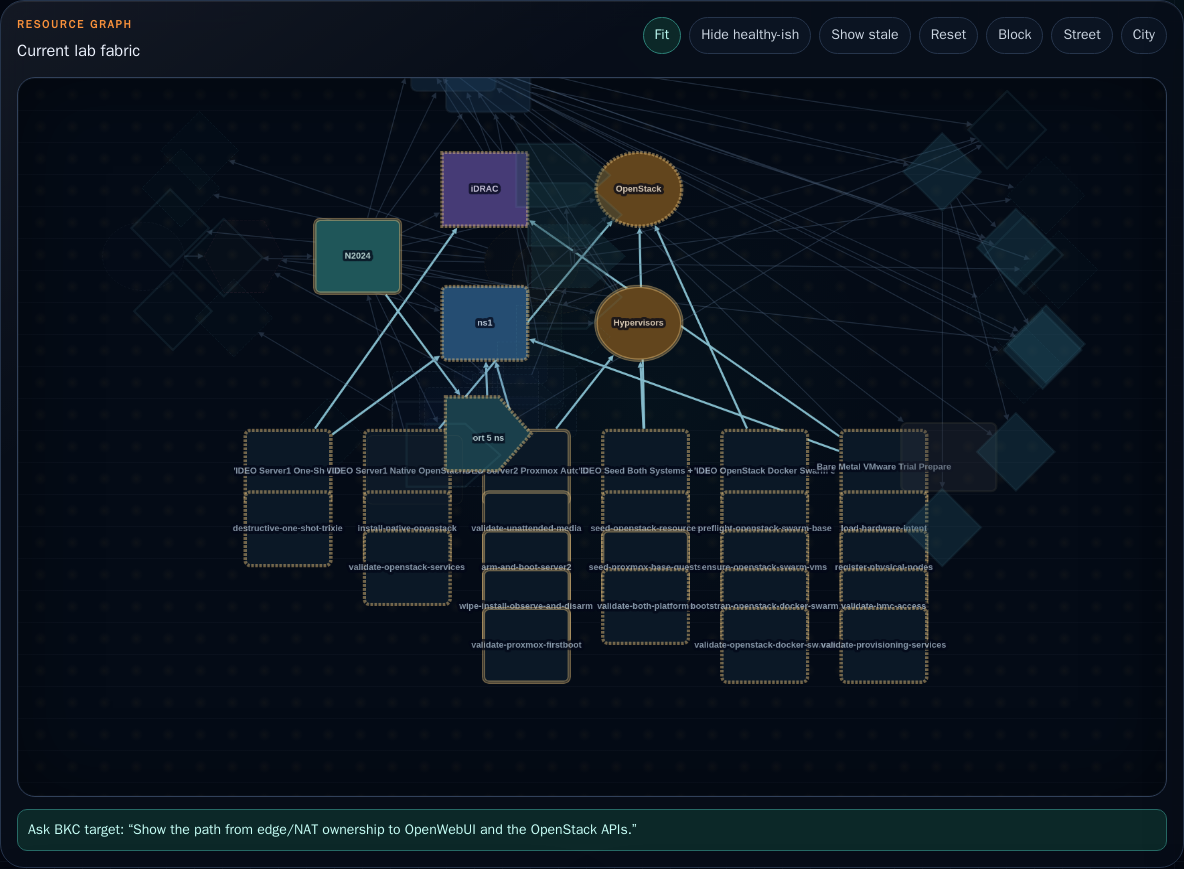
The sequence we proved
The lab work was deliberately grounded in real hardware and real services:
- power control through iDRAC/IPMI;
- PXE boot paths for destructive bare-metal rebuilds;
- Debian Trixie base provisioning;
- OpenStack lab bring-up on one server;
- Proxmox and ESXi lanes on another server;
- Docker Swarm workload seeding;
- Portainer, Grafana, Horizon, OpenWebUI, and edge routes;
- screenshot capture and public documentation updates.
That is a lot of surface area, but each step is normal IT work. The product idea is not that BlackKnightController invents a new universe. The product idea is that it keeps these actions, relationships, and proofs close enough together that the next operator does not have to rediscover the whole story.
Why screenshots matter
Screenshots are not decoration here. They are field evidence.
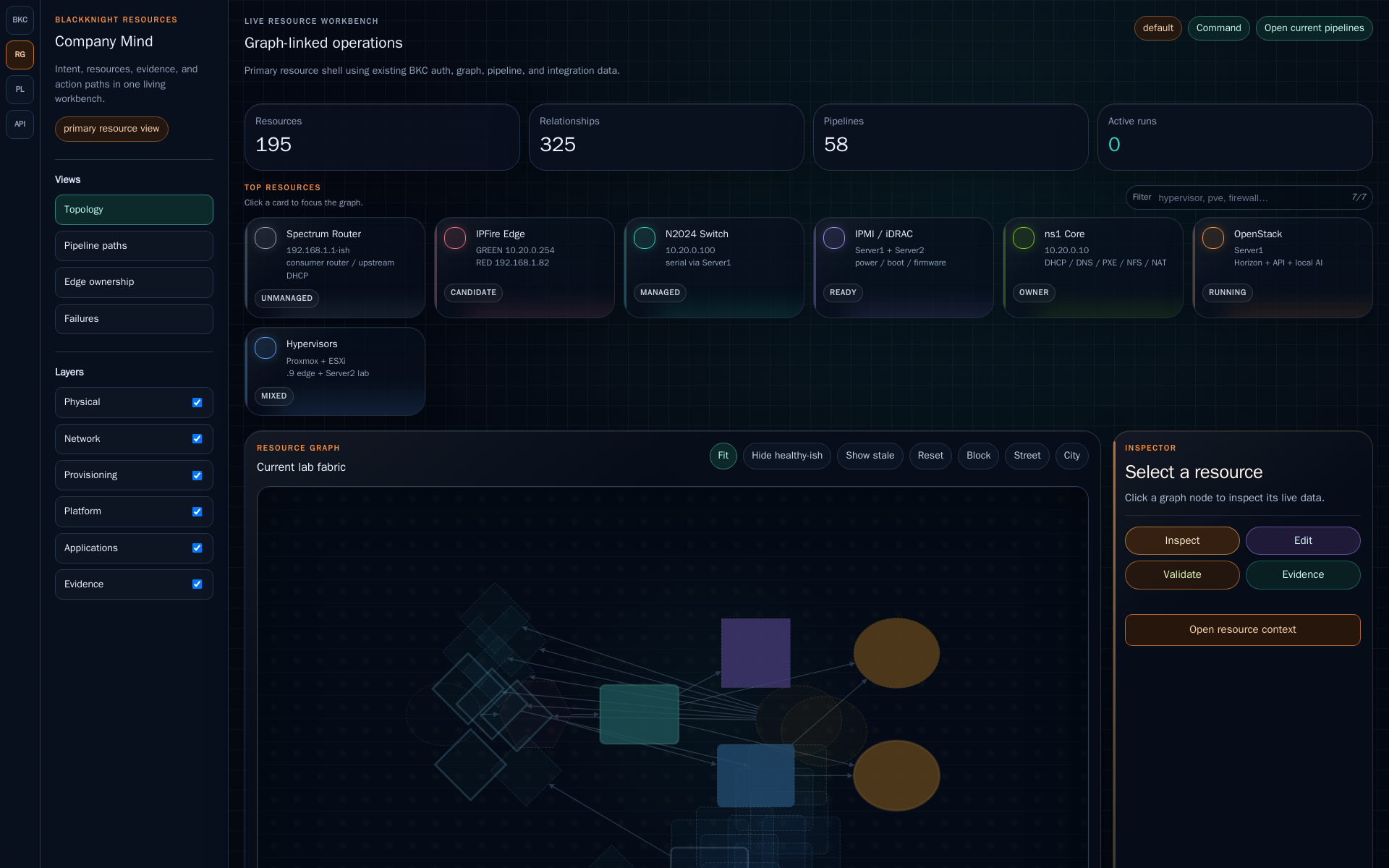
The Company Mind view shows resources and relationships as an operating graph: hypervisors, swarms, networks, services, pipelines, and edge paths. That makes the lab readable at a glance, and it gives a human/operator pair a shared map to reason from.
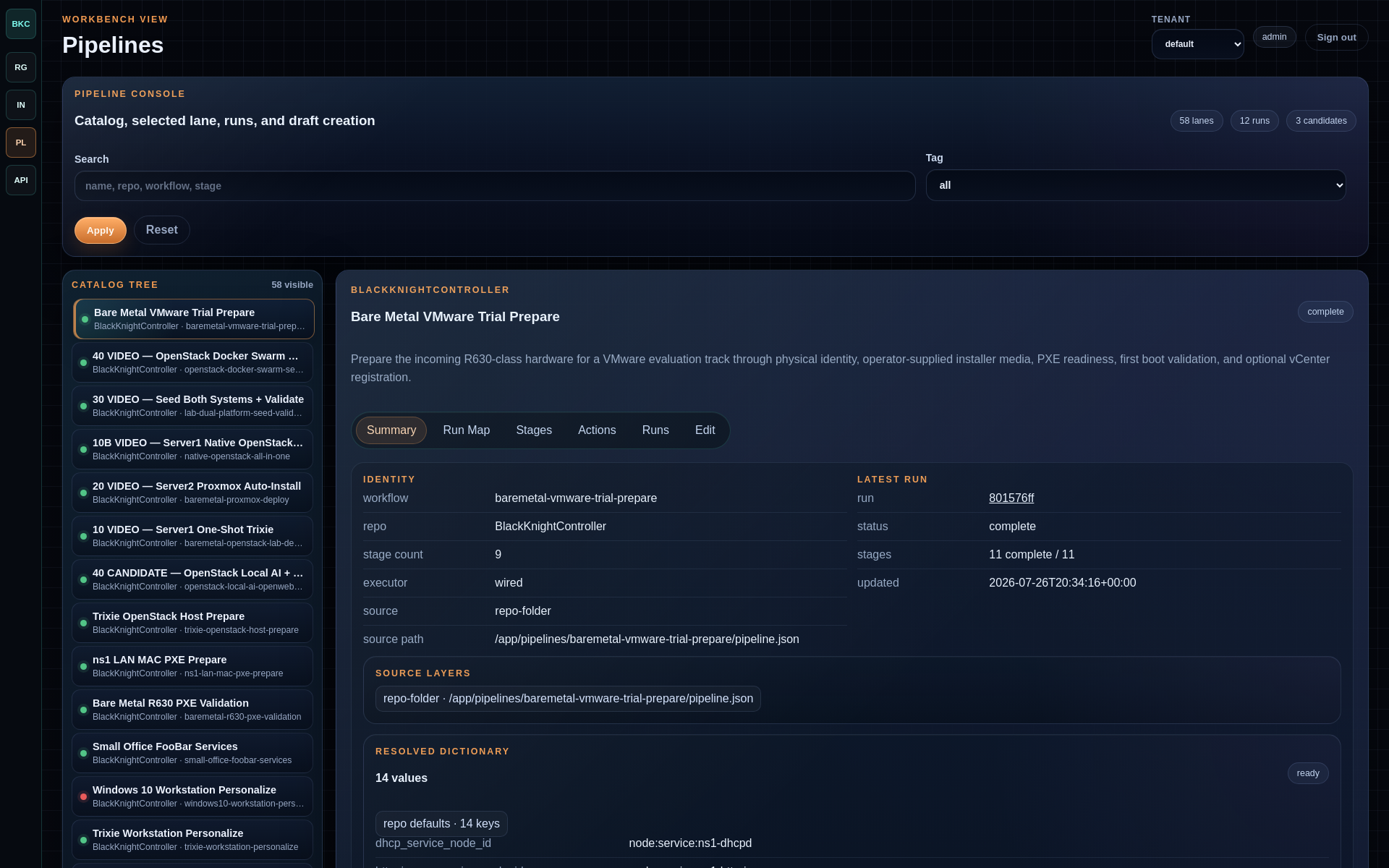
The pipeline workbench shows the other half: repeatable action. Discovery work does not count as finished until the useful command, template, API call, or validation check lands back in a pipeline.
The business meaning
A small team usually does not fail because nobody can run a command. It fails because the context is scattered:
- the BIOS setting is in one person’s memory;
- the DHCP exception is in an old shell session;
- the proxy rule was tested but never documented;
- the VM seed step worked once but was not promoted;
- the dashboard exists but is not tied to deployment evidence.
BlackKnightController is aimed at that gap.
The conservative business case is straightforward: reduce rediscovery, reduce rework, shorten rebuilds, preserve operational knowledge, and make client environments easier to teach, migrate, and support.
What this can do for a client
Auzietek is not asking a client to buy a science project because the diagrams look fun. The practical service path is smaller and more grounded:
- map what is already running;
- identify the few fragile places that create the most support pain;
- turn repeatable fixes into scripts, templates, or pipelines;
- validate those actions against real hosts and services;
- leave behind screenshots, runbooks, and operating fragments the team can reuse.
That can start as a lab rebuild, a small-office virtualization cleanup, a Docker Swarm or Kubernetes review, a DNS/certificate audit, or a migration plan for an aging host. The same loop applies: preserve evidence, reduce mystery, make the next run calmer.
Why the UI matters
The UI is not only decoration. A clear view changes the conversation.
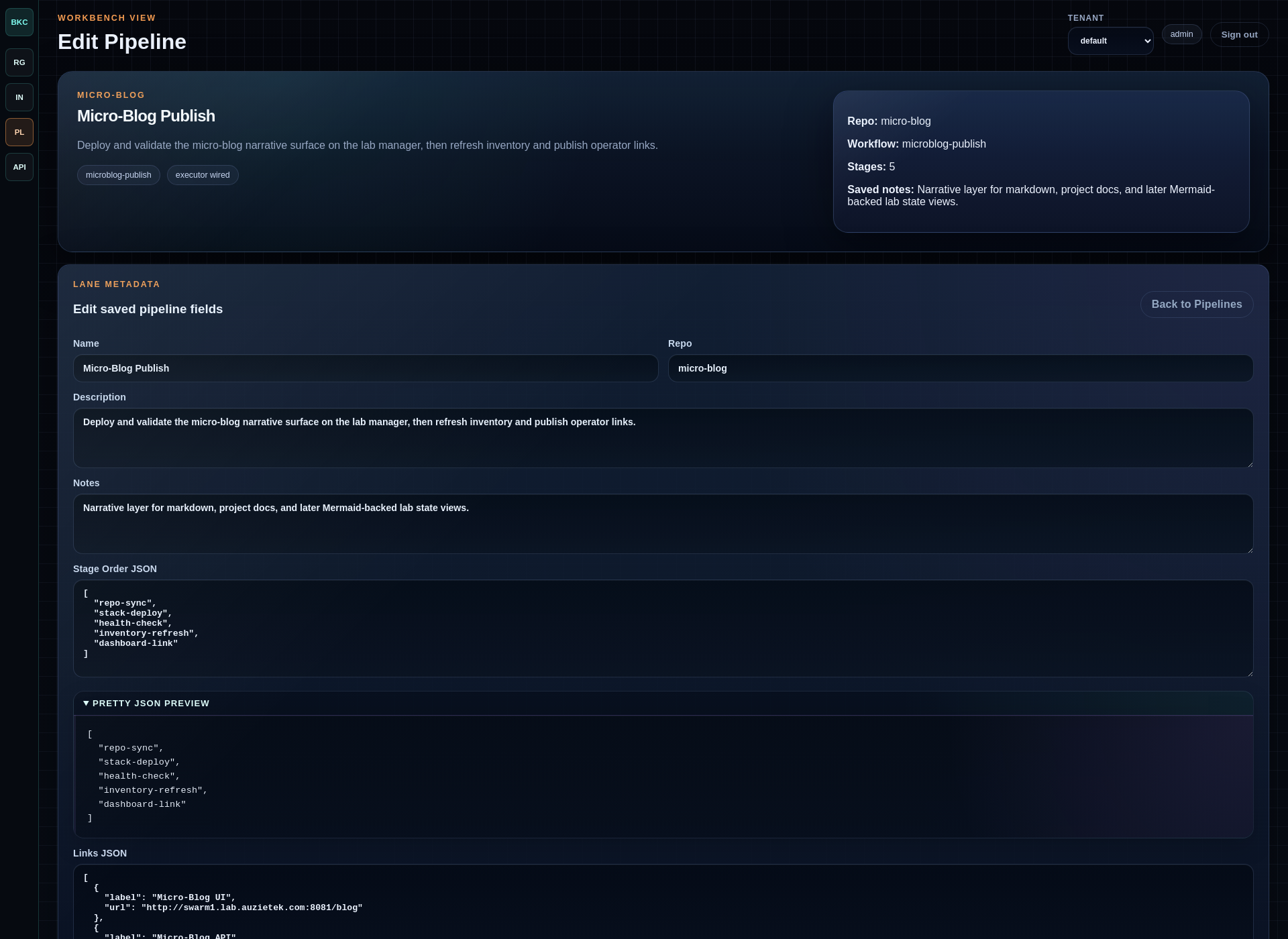
When the pipeline editor shows JSON, shell fragments, resources, and run status in one place, it becomes easier to decide whether a fix is actually ready to promote. When the graph view shows a service hanging off a hypervisor, a switch, an edge route, and a monitoring dashboard, it becomes easier to teach another person what exists without forcing them to reconstruct the whole lab from terminal scrollback.
The long-term product value is this connected operating memory:
resource
  -> relationship
  -> action
  -> evidence
  -> known-good fragment
  -> public or private teaching material
What comes next
The next public pass should keep expanding the magazine-and-repo pattern:
validated lab pipeline
  -> public article
  -> screenshot evidence
  -> GitHub guide or companion kit
  -> repeatable service offer
That is the Auzietek way: not “you could do this,” but “we did this, here is the proof, here is the lesson, and here is the path for doing it again.”
Related: BlackKnightController pipeline articles, Auzietek Linux Lab Guides.